
How we work · Our compliance system
From first review to continuing assurance
Team 9’s senior practitioners take your organisation through six stages: understanding each premises and its surroundings, auditing it in detail, advising your board, drafting your operational plans, training your staff and then keeping all of it current, year after year.
Every stage produces professional work you keep: reports, plans, training records and, from Year 2, a continuing view of every property you are responsible for.
What you receive
Six stages, each with work you keep
Year 1 establishes a sound, documented position for each premises. From Year 2, Team 9 keeps that position current and gives your leadership a continuing view across every property.
Year 1 · Assessment and implementation
- 01Understand
Hyperlocal security report
- 02Assess
220-point premises audit
- 03Advise
Board-level Compliance & Security Assessment
- 04Design
Draft evacuation, invacuation, lockdown and communication plans
- 05Train 24/7
Online staff training with completion and version records
Year 2 onwards
- 06Assure
Annual practitioner review, current plans, training oversight and estate-wide visibility
Senior practitioner judgement at every stage. Team 9’s own technology supports consistent delivery, accountability and evidence; the advice is always a practitioner’s.
01Understand
The premises in its real surroundings
Before the audit, a senior practitioner reviews your existing arrangements, and Team 9 prepares a hyperlocal security report on the area around each premises.
- What our practitioners do
- Review current procedures, plans, training records and responsibilities, and research the surrounding area within a defined radius using open-source intelligence.
- Why it matters
- Risk does not stop at the front door. Neighbouring venues, the night-time economy, protest routes, crime patterns and roadworks all affect how people arrive, leave and evacuate.
- Supported by
- Structured research across official threat, crime, licensing, planning, transport and public-order sources. Each risk is rated for likelihood, impact and confidence.
- You receive
- A hyperlocal security report with a rated risk matrix and areas for consideration.
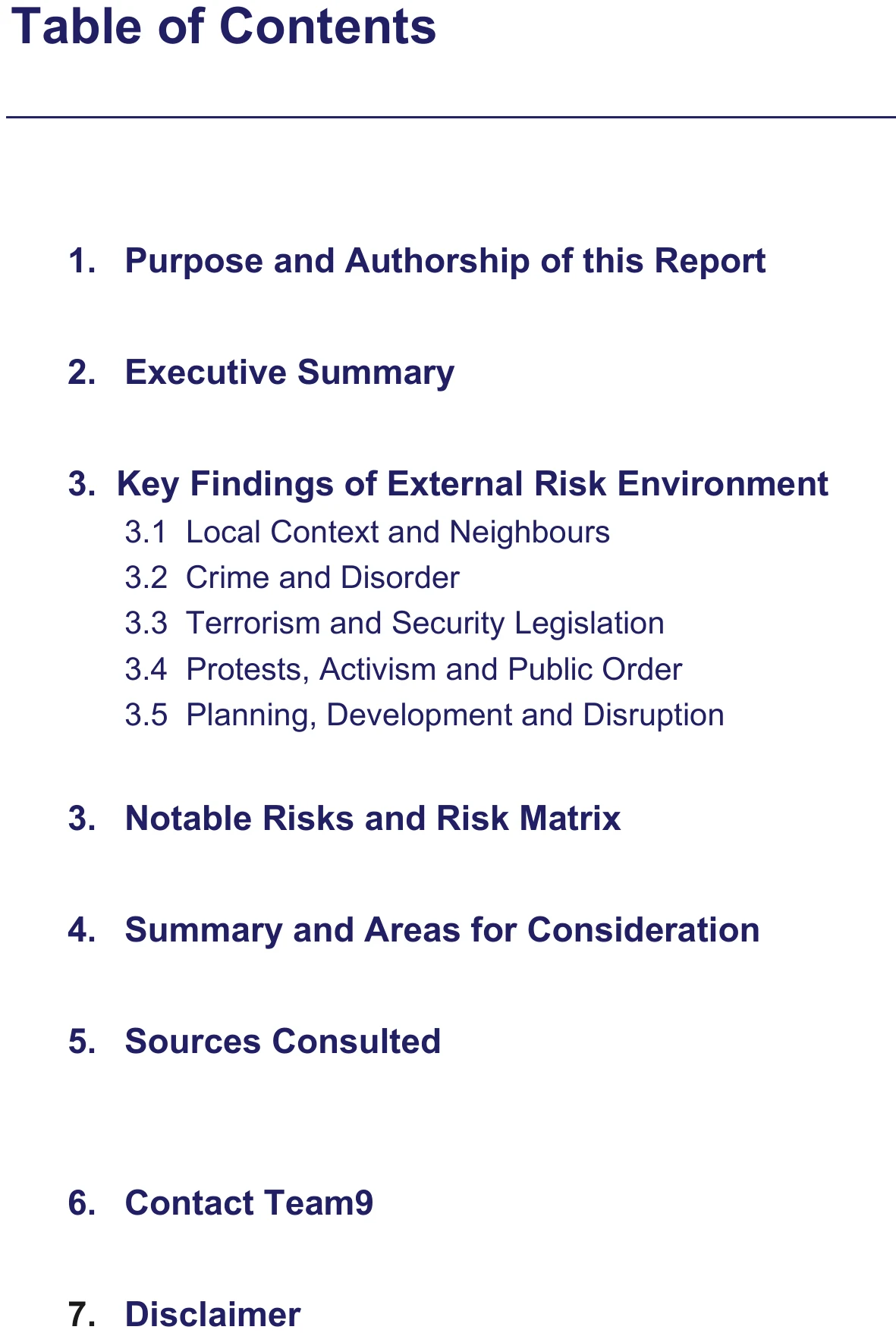
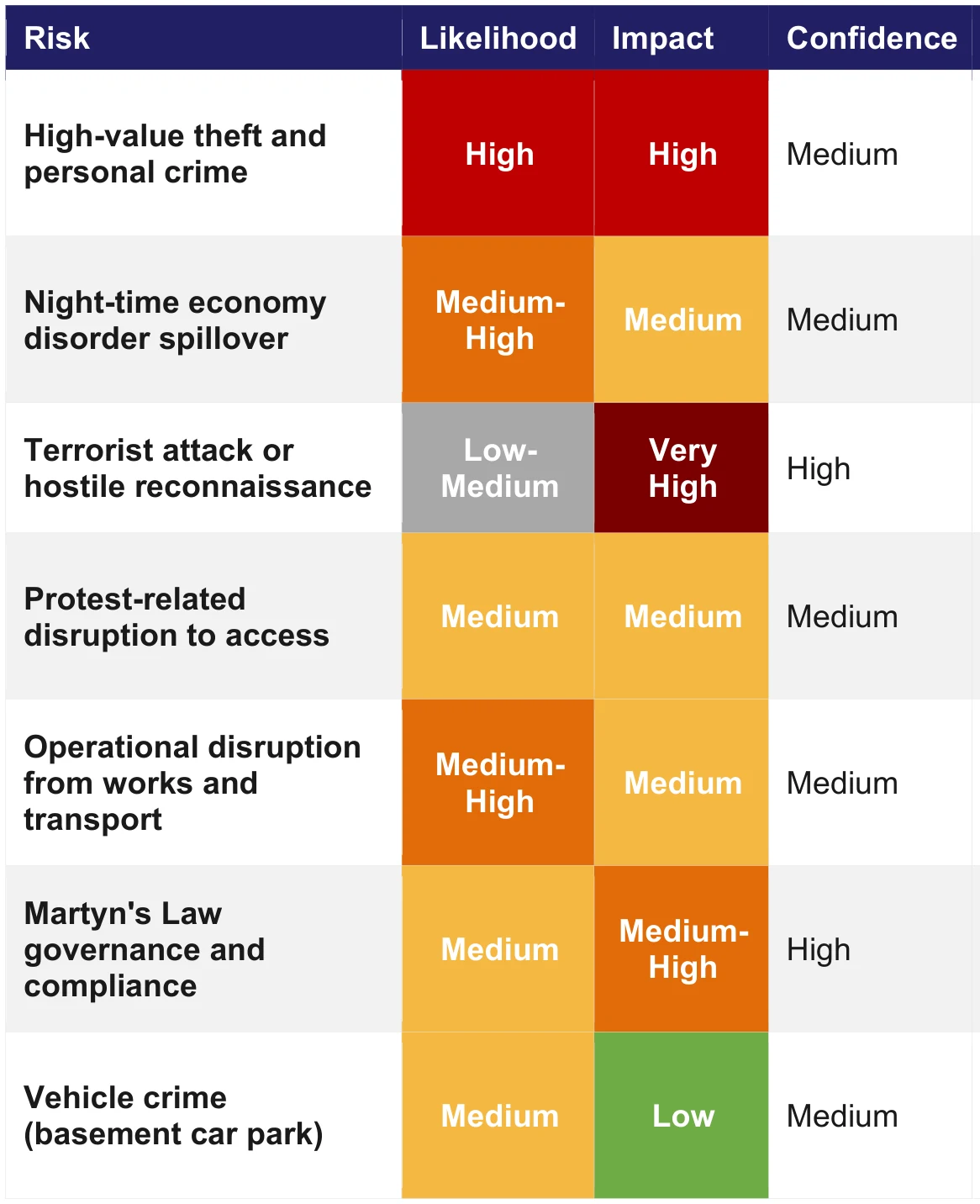
What the report examines
- Local context and neighboursWhat surrounds the premises, and when footfall peaks.
- Crime and disorderRecorded crime patterns and what they mean for guests, staff and visitors.
- Terrorism threat and legislationThe national threat level and the premises’ position under Martyn’s Law.
- Protest and public orderRecent activity and a forward look at planned events.
- Planning, works and transportDisruption that could affect access, deliveries or evacuation routes.
- Risk matrix and next stepsEach risk rated, with areas for the organisation to consider.
“It is designed to support informed executive oversight and to provide an evidence base for engagement with insurers, regulators and specialist advisers.”
From the hyperlocal report’s statement of purpose
The local picture tells the audit where to look hardest.Stage 02 · Assess
02Assess
A 220-point premises audit, carried out on site
A senior practitioner audits each premises in person using Team 9’s own tablet application. The method is ISO-informed, and every site is assessed against the same version-controlled structure.
- What our practitioners do
- Walk the premises with your team, test how procedures would work in practice, and record findings, photographs and observations against each point.
- Why it matters
- Consistent, traceable evidence. Each point separates what the Act requires from guidance, good practice and the auditor’s own observations, so findings can be compared across an estate.
- You receive
- A completed premises audit: the evidence base for your Compliance & Security Assessment.
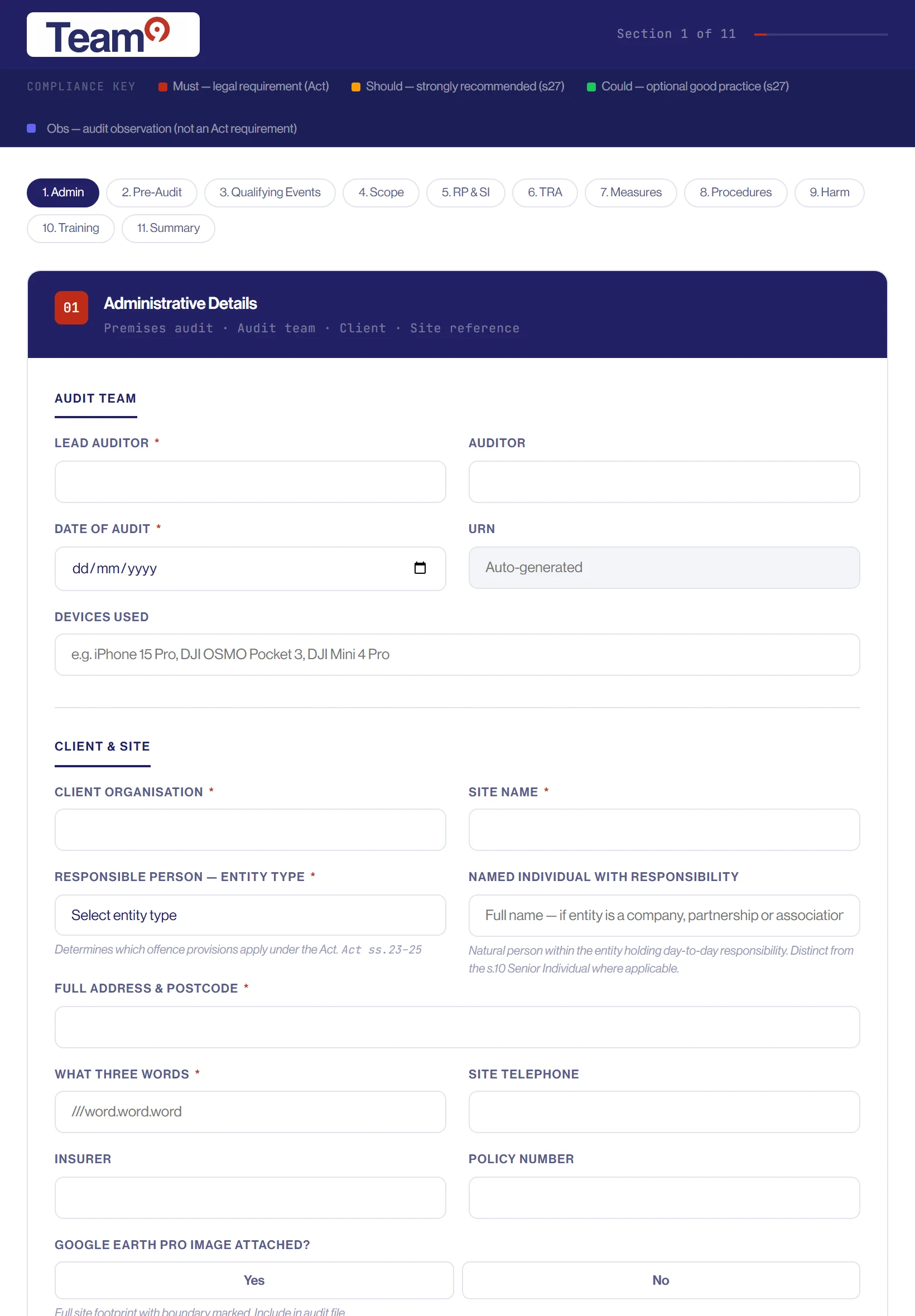
What this screen records
- The audit team, the date and the devices used to capture images.
- A unique reference for every audit, generated automatically.
- The responsible person’s legal form, which determines which offence provisions of the Act apply.
- The site’s insurer and policy number, where an insurer needs sight of the work.
- A precise location and the on-site contact.
Audit findings feed directly into the report your board receives.Stage 03 · Advise
03Advise
A Compliance & Security Assessment your board can act on
The Compliance & Security Assessment (CSA) is Team 9’s principal deliverable. It includes the risk assessment, and sets out what already works, where genuine gaps remain, why each recommendation is made and what it is likely to require.
- What our practitioners do
- Analyse the audit and the local picture, assess each requirement of the Act and set out proportionate, reasoned recommendations. A reviewing consultant checks the report before it is issued.
- Why it matters
- Boards need to know what the law requires, what is good practice and where spending is genuinely justified. The CSA keeps the three apart.
- Supported by
- A structured report built from the audit, with each finding cross-referenced to the relevant provision of the Act and to published guidance.
- You receive
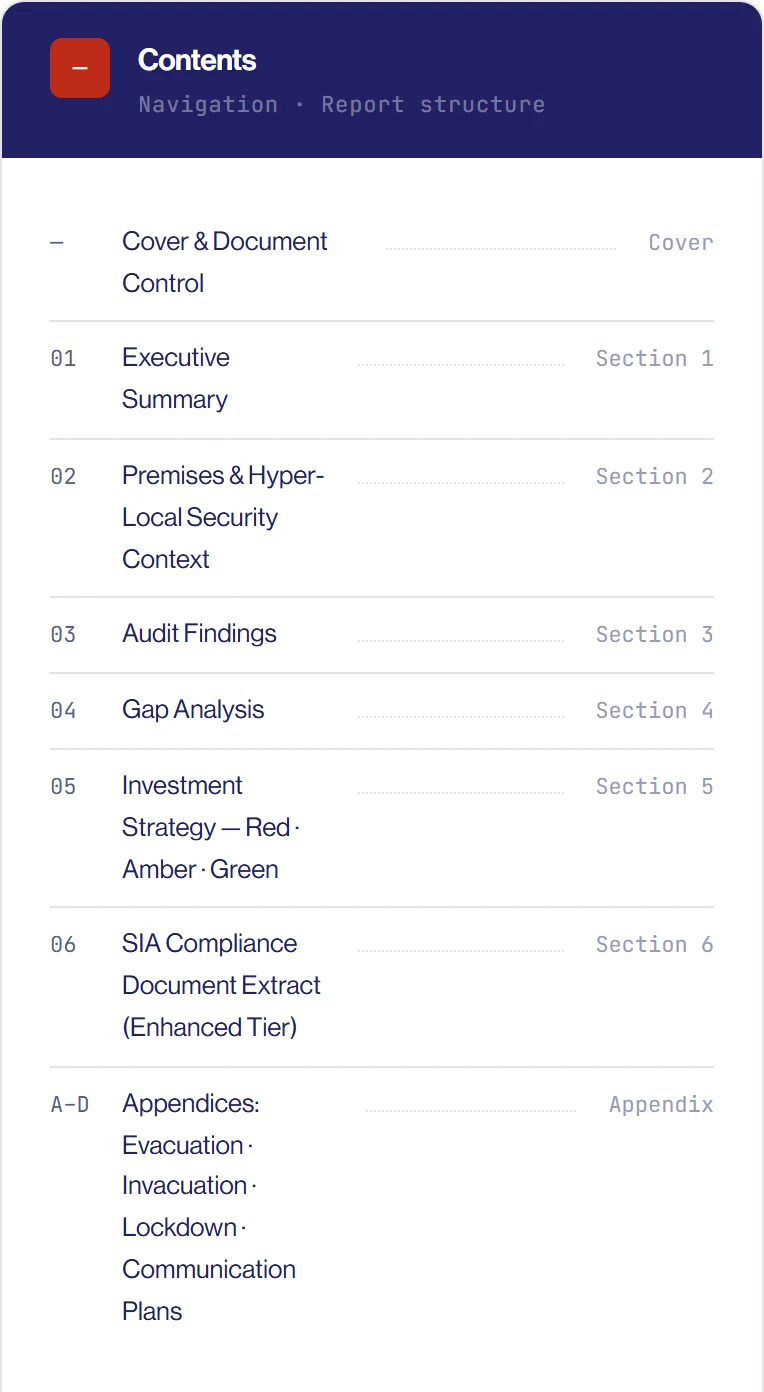
- A board-level report: executive summary, premises and local context, findings, gap analysis, a red–amber–green investment strategy and, for enhanced-tier premises, a draft compliance document.
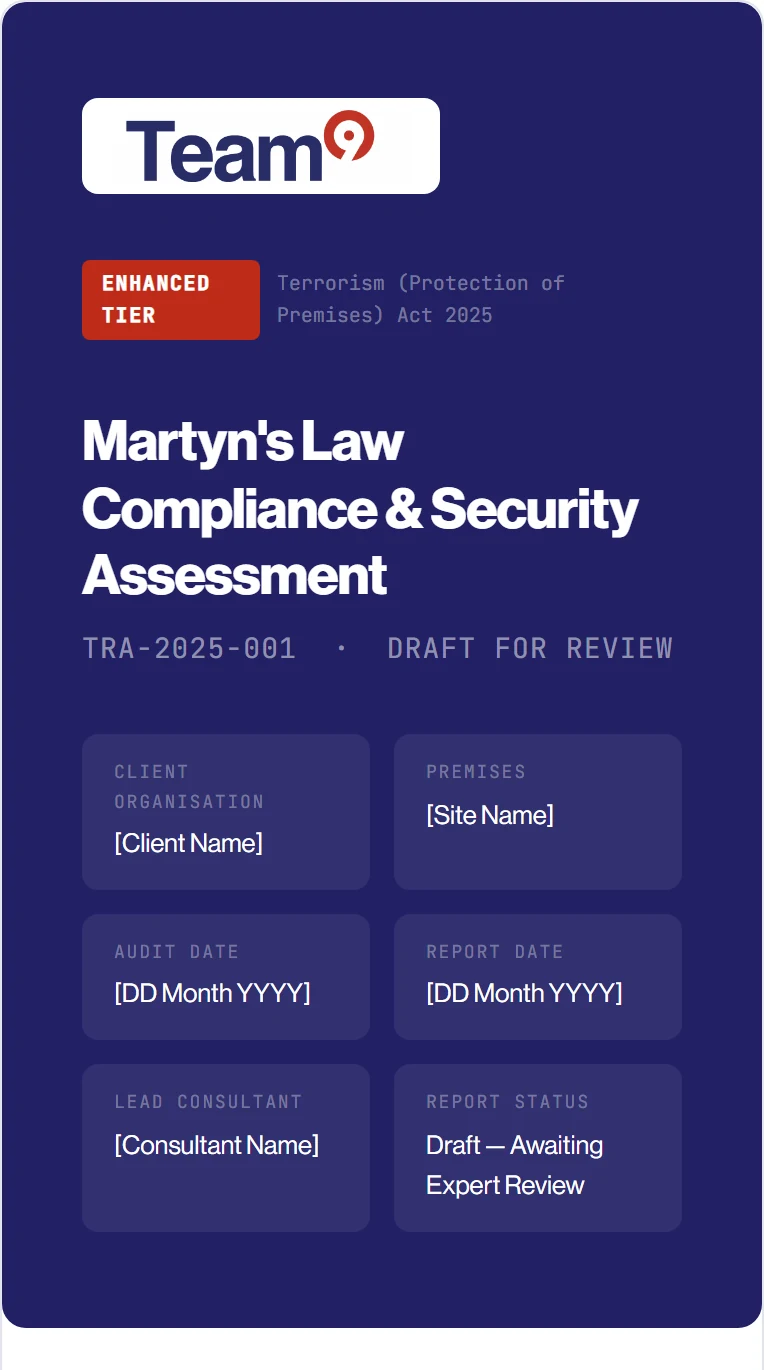
How priorities are set
- RedAddress now. The premises is unlikely to be compliant until action is taken.
- AmberPlan and budget. Strongly recommended; include it when reviewing capital expenditure.
- GreenGood practice. Worth considering as security maturity develops.
Each recommendation states its legislative or guidance basis, a timeframe and what it requires: a board decision, a specialist contractor, training or internal work. What already works is recorded too, so effective arrangements are kept rather than replaced.
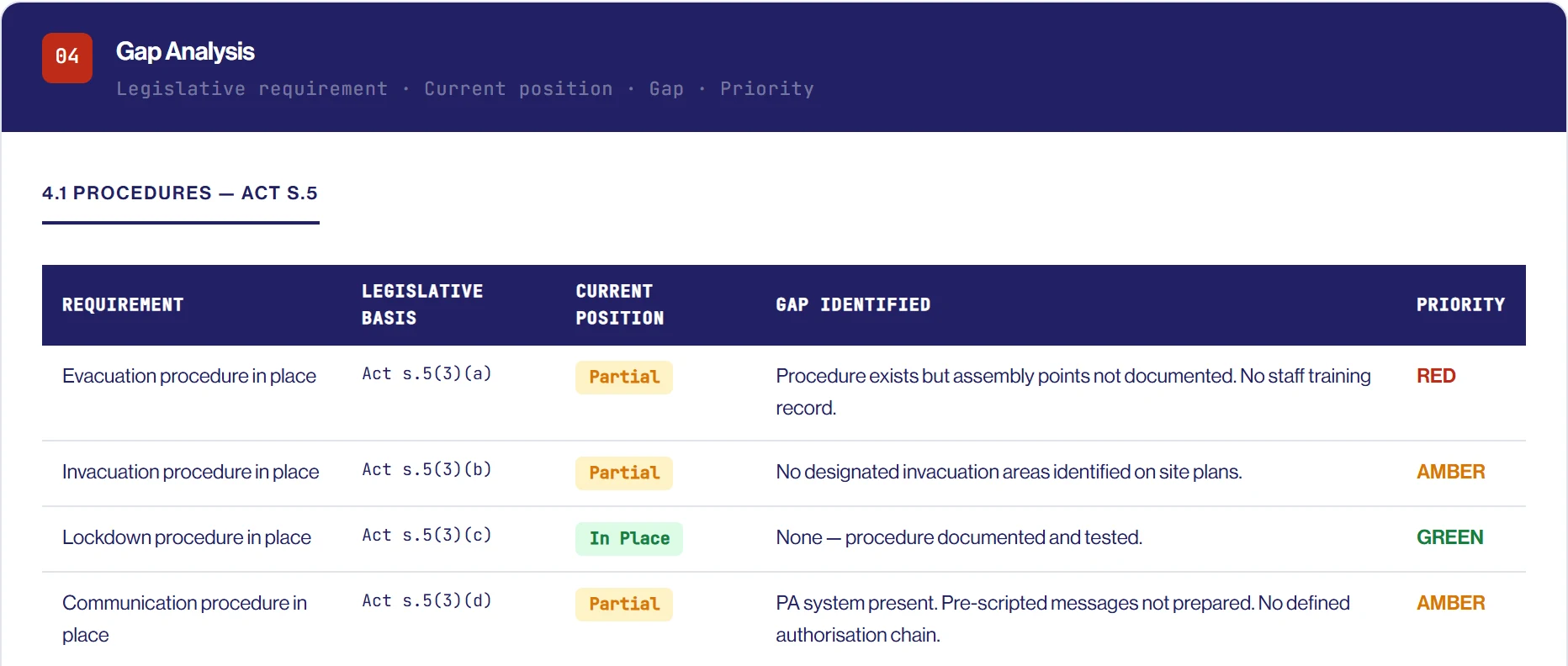
The gap analysis lists every requirement with its legal basis, the current position, the gap identified and its priority, including what is already in place.
Three recommendations from the investment strategy
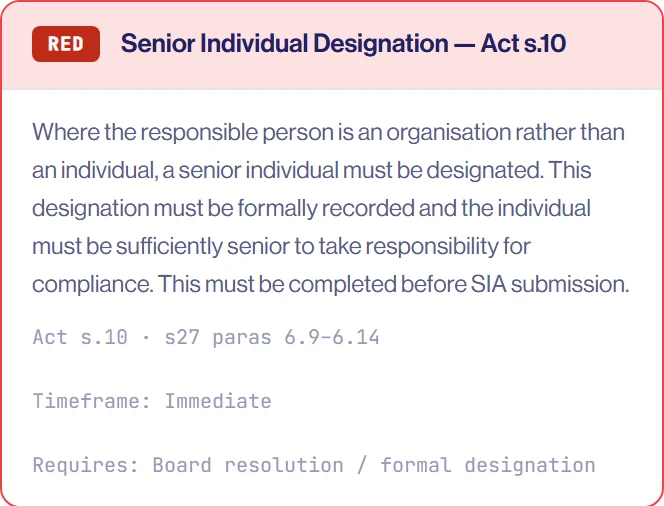
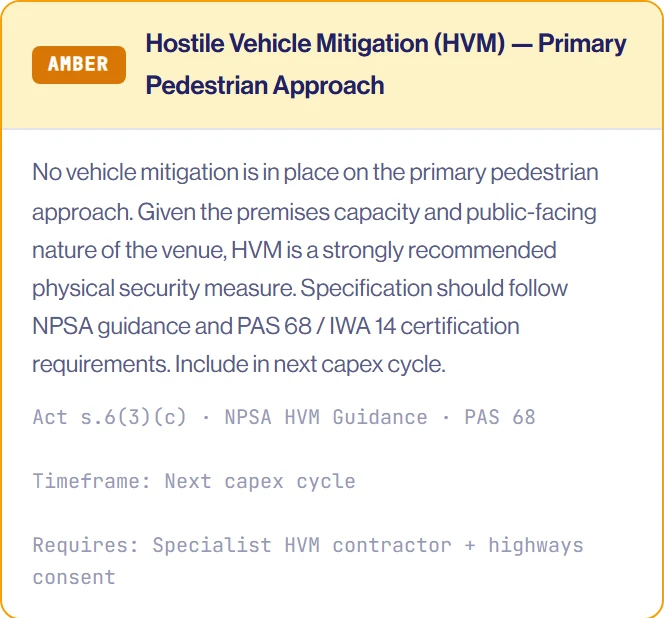
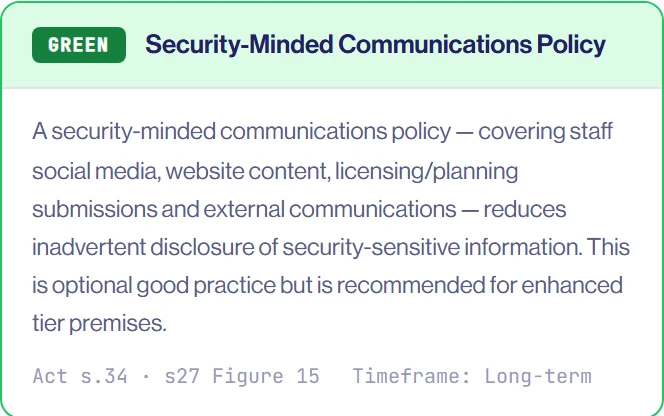
The report extracts above show Team 9’s assessment template with illustrative findings. They do not describe real premises.
What the board then decides
- Priorities and ownersWhich red items to resolve first, and who is accountable for each.
- The case for investmentWhich amber measures to budget for, and in which cycle.
- Adoption of plansWhether to adopt the draft operational plans prepared at the next stage.
Considering an assessment for one premises or a whole estate?
Discuss scope with a senior practitionerThe assessment sets out what each premises needs. The plans come next.Stage 04 · Design
04Design
Plans written for each premises, for your responsible person to adopt
Team 9 drafts the operational plans each premises needs, based on the assessment and written around its layout, staffing and setting. They are presented to the responsible person to consider, approve and adopt. The decision remains yours.
- EvacuationMoving people out and away from a threat, separate from the fire evacuation plan.
- InvacuationMoving people to a safer place inside the premises.
- LockdownPreventing a threat from entering and protecting the people inside.
- CommunicationHow staff are alerted, what people are told and how the emergency services are informed.

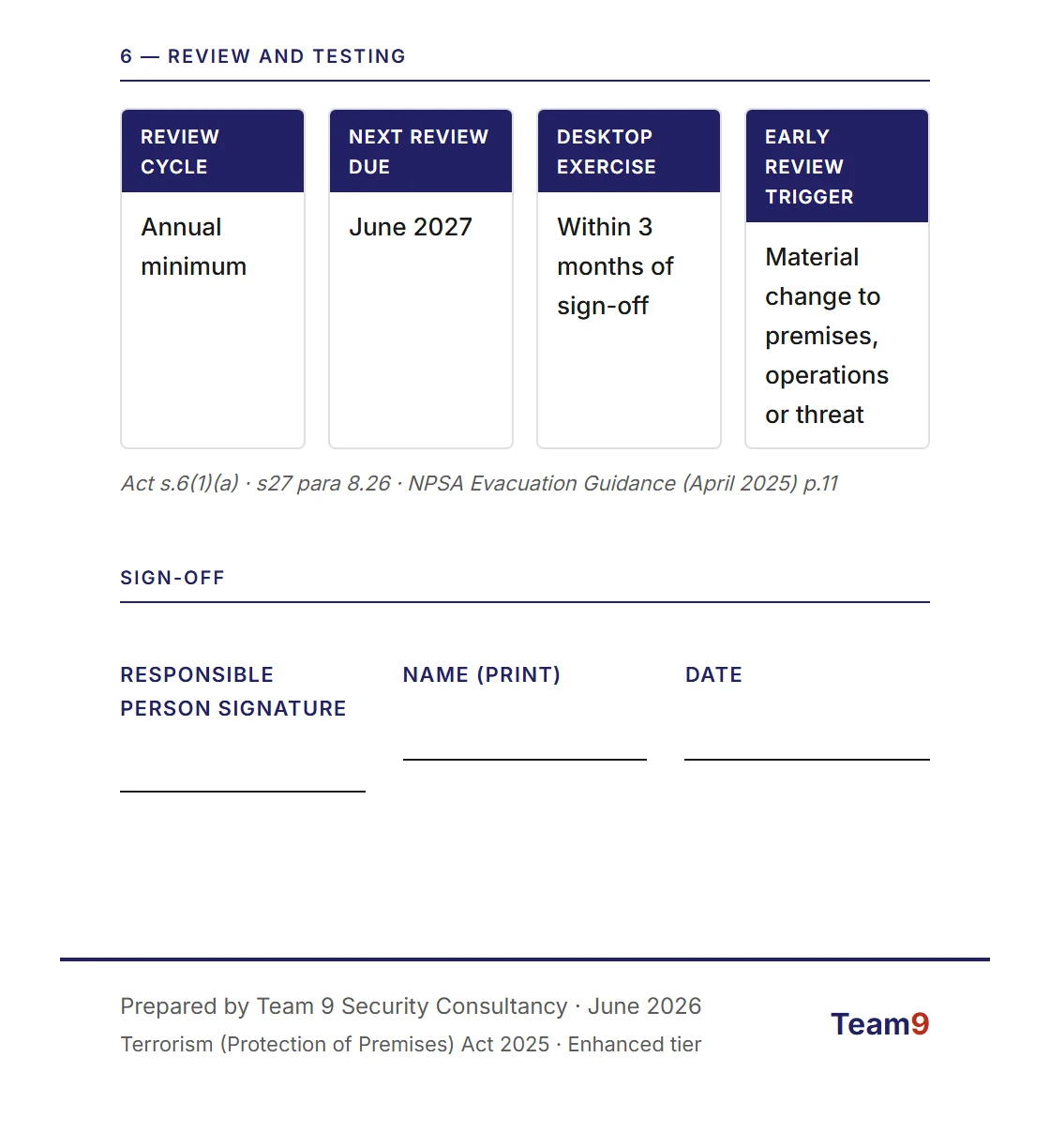

Team 9 drafts and explains
Your responsible person approves and adopts
- What our practitioners do
- Draft each plan from the assessment, check it against the building and its staffing, and revise it with your team.
- Why it matters
- A plan that names the decision-maker, the roles and the words to use is far more likely to work under pressure than a generic template.
- Supported by
- Version control and the client portal. Each plan is issued as a standalone document so it can be found quickly during an incident.
- You receive
- Draft plans referenced to the Act and national guidance, with review dates and testing commitments.
Floor plans, exit details and scripted instructions are specific to each premises and are not shown.
Adopted plans become the basis of staff training.Stage 05 · Train 24/7
05Train 24/7
Online training built on your approved procedures
Once your plans are adopted, Team 9 provides online training based on them. Staff can complete it at any hour on their own phone or a shared device, and every completion is recorded against the premises and the version of the module.
- What our practitioners do
- Tailor the training to the procedures your responsible person has approved, and update it when those procedures change.
- Why it matters
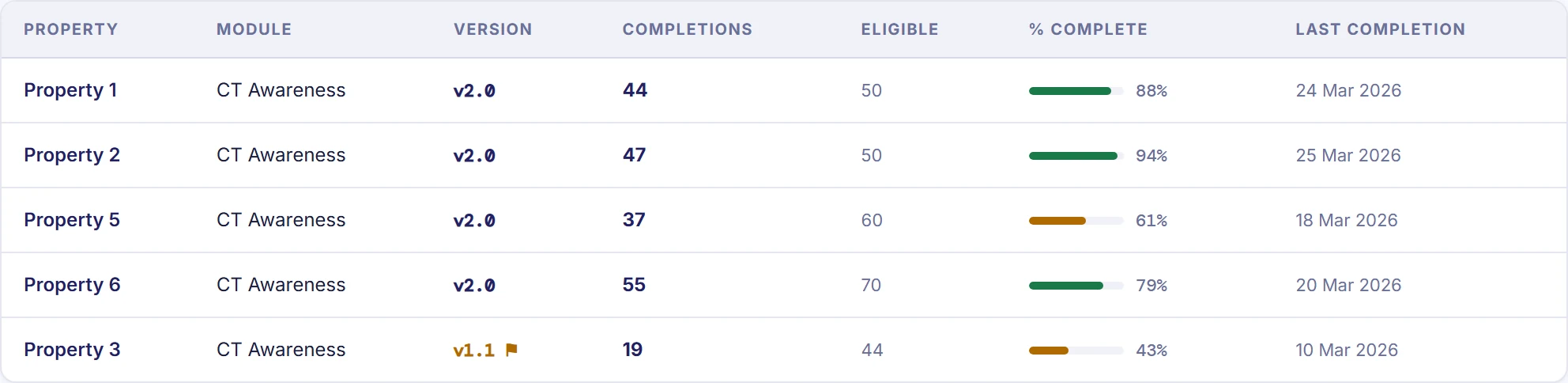
- Staff who know the procedure act sooner. Records show who has completed which version, and where refresher training is due.
- Supported by
- The Team 9 training portal, and the completion register in your client portal.
- You receive
- Training access for each premises, with completion and version records.
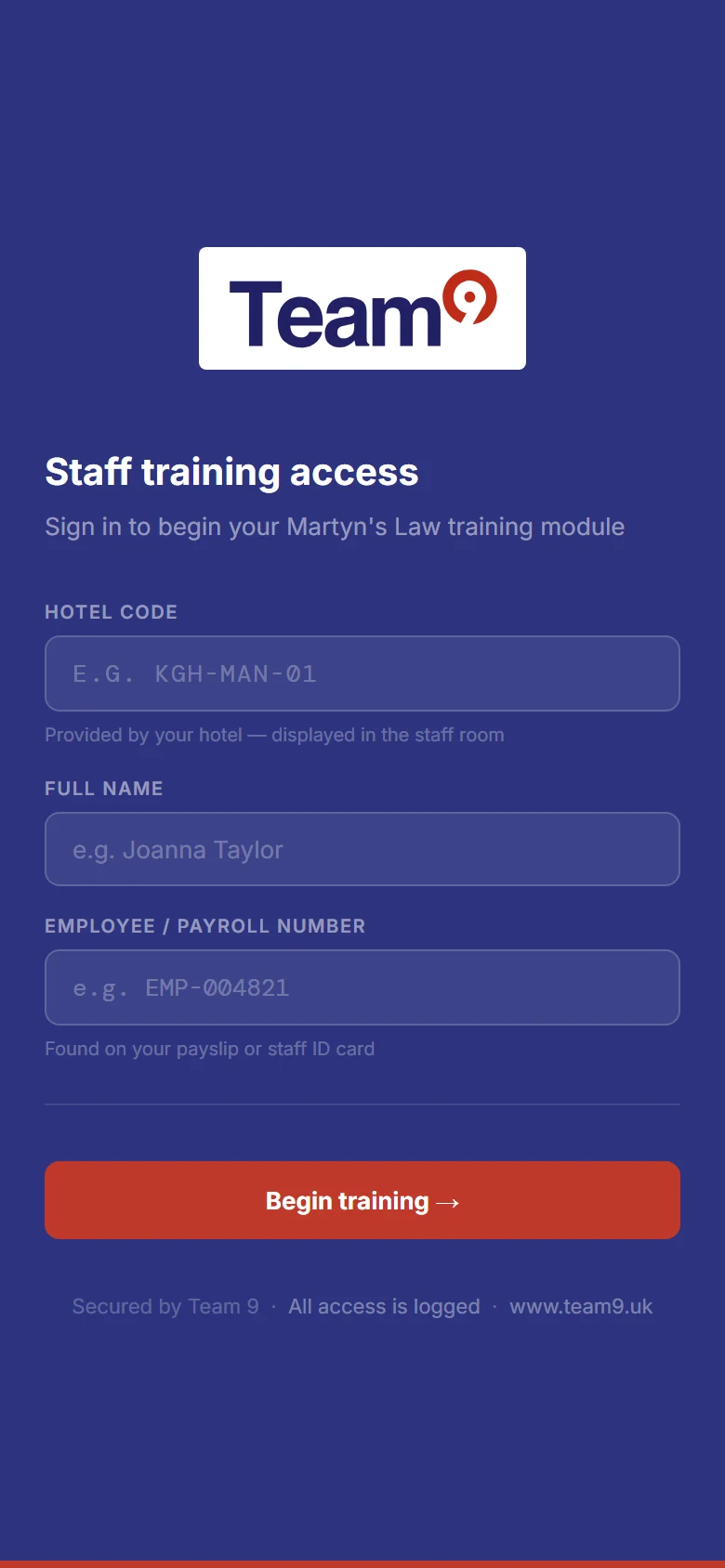
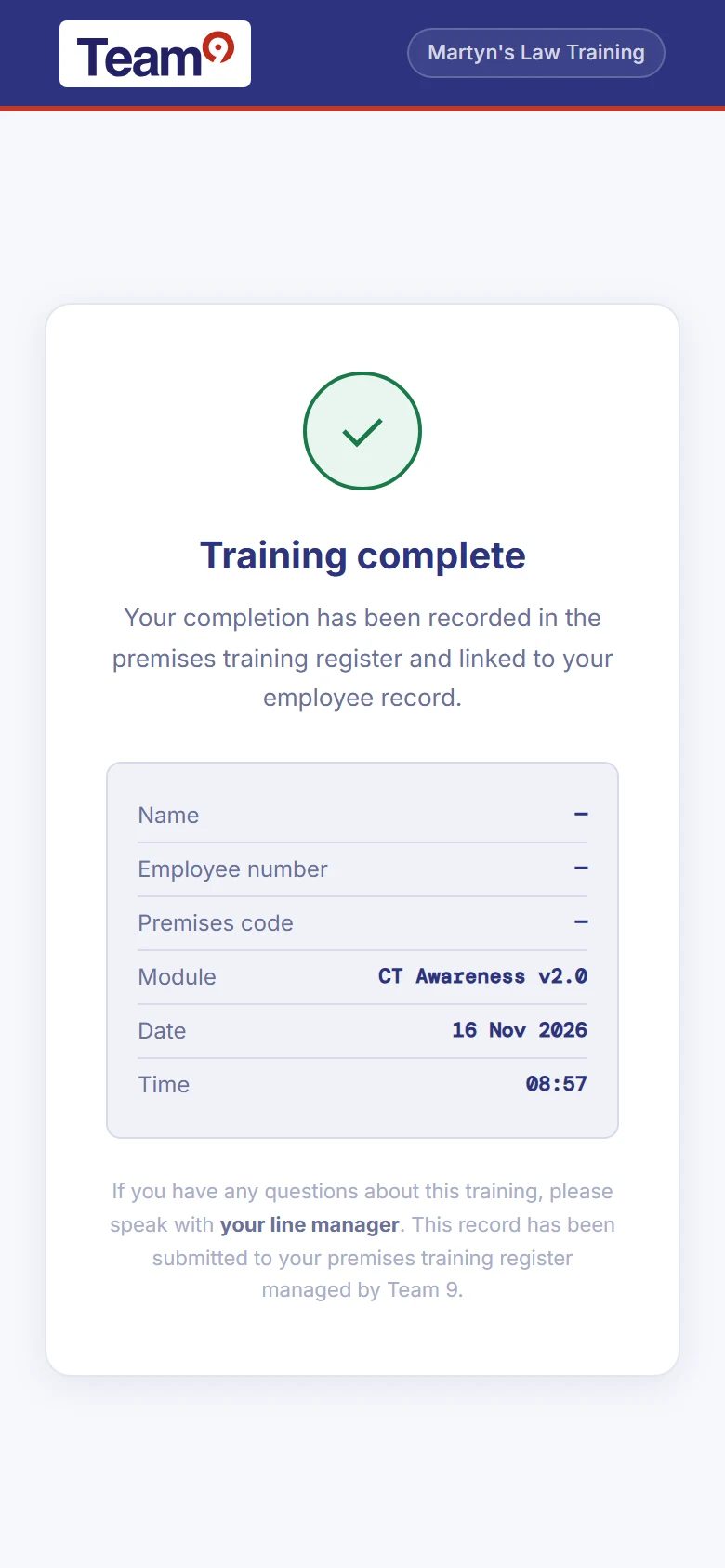
The completion register
Training completes Year 1. From Year 2, Team 9 keeps all of it current.Stage 06 · Assure
06Assure · Year 2 onwards
Continuing assurance, for one premises or an entire estate
Compliance is not a one-off report. From Year 2, Team 9 keeps your assessment, plans and training current, reviews them with you every year and gives your leadership a clear view of every property you are responsible for.
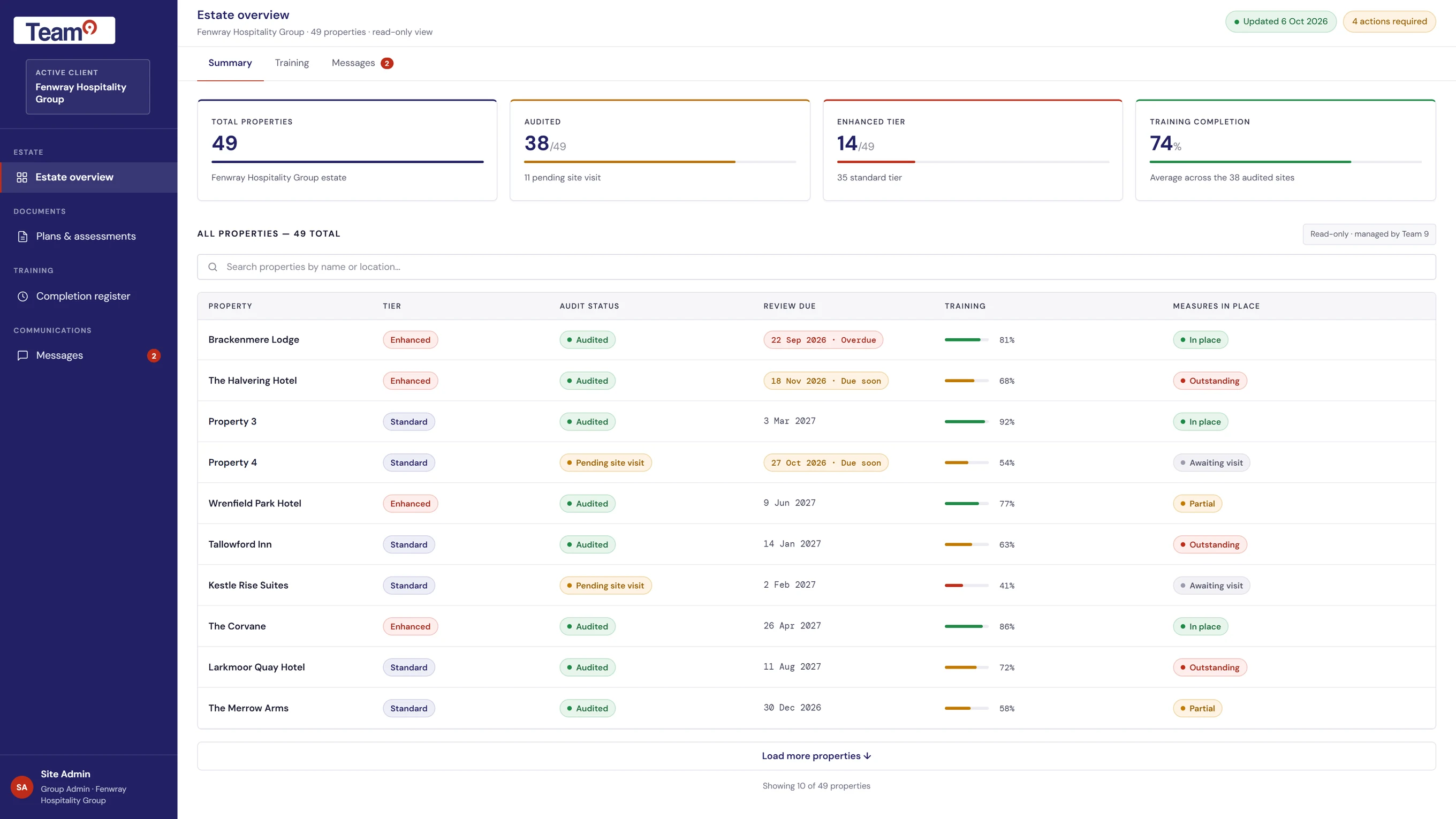
Scroll sideways to see the whole estate view.
- Estate totalsProperties, audit progress, enhanced-tier premises and average training completion.
- Matters requiring attentionOutstanding actions, and when the record was last updated.
- Audit statusWhich properties are audited and which await a site visit.
- Review datesOverdue and due-soon reviews, flagged property by property.
- Training by propertyCompletion against eligible staff at each site.
- Measures in placeWhether recommended measures are in place, partial or outstanding.
Every year, Team 9 continues to
The annual relationship is led by senior practitioners. The portal records the work; it does not replace it.
- Lead an annual reviewA senior practitioner reviews each premises’ measures, plans and documentation, and updates the assessment where anything has changed.
- Keep plans and documents currentTeam 9 issues new versions, archives earlier ones and tracks every review date.
- Monitor regulation and adviseChanges to guidance, the regulator’s requirements and the threat picture are turned into specific advice for your premises.
- Oversee trainingCompletion is tracked by premises and module version, with refresher training flagged when procedures change.
- Track what needs attentionReviews due, measures outstanding and actions required, property by property.
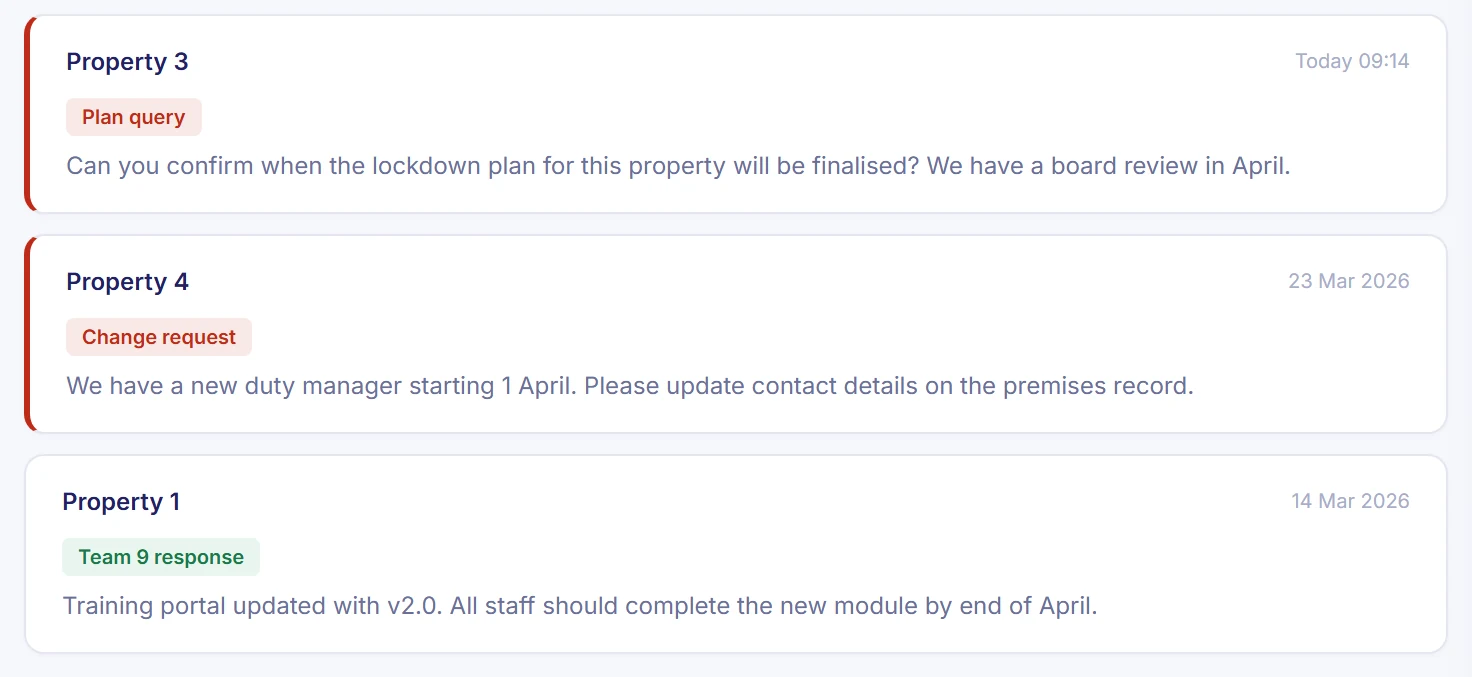
- Answer your questionsPlan queries and change requests are raised against the property concerned and answered by Team 9.
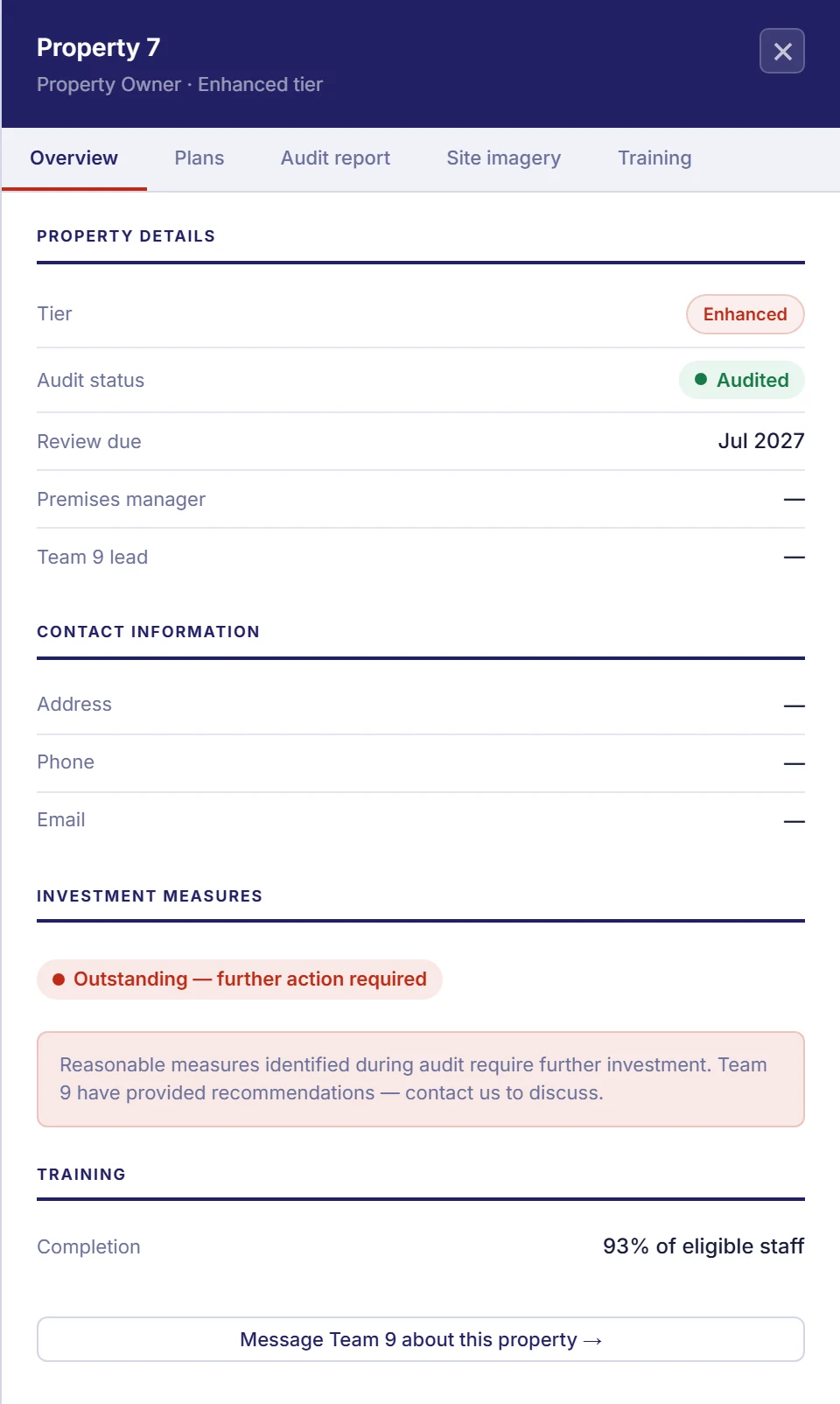
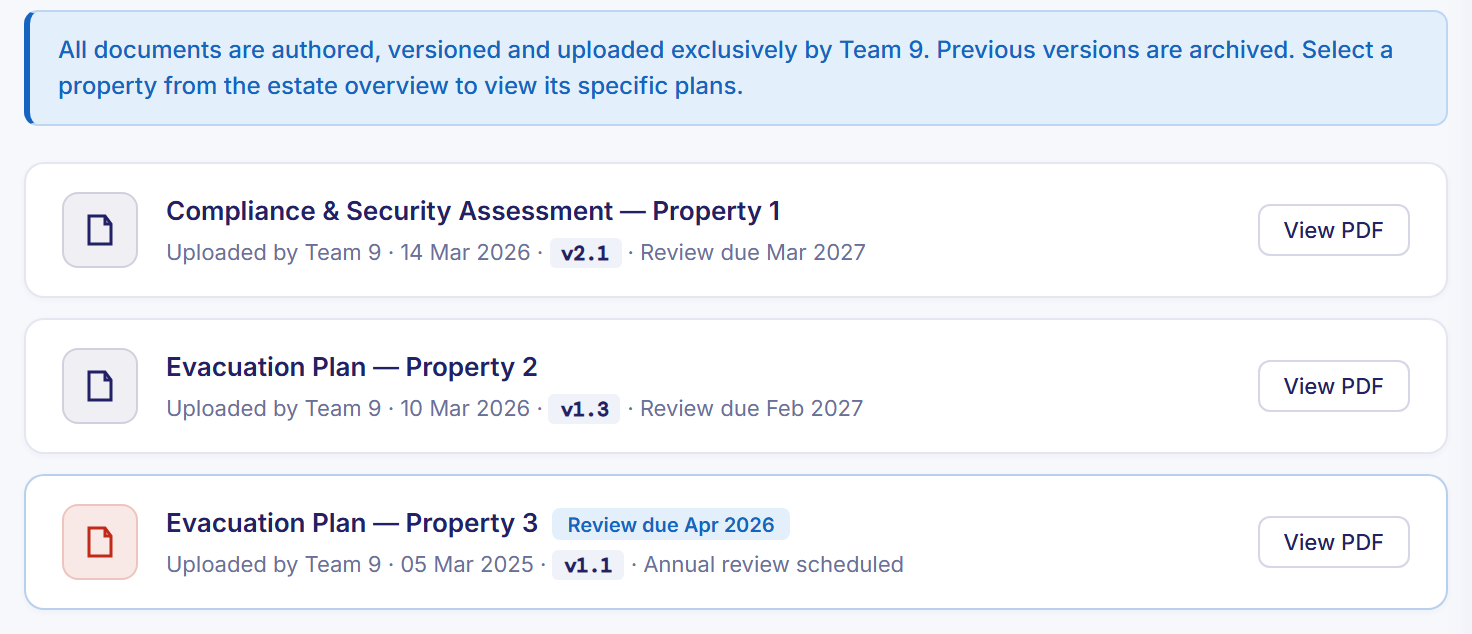
Continuing professional assurance
Senior practitioners remain accountable for the advice, from the first review to every annual review that follows.
For a hotel group, an education estate or any organisation with many sites, that means one coordinated programme: the same standard at every premises, a clear view of where attention is needed, and a named senior practitioner to turn to when something changes.
Start a conversation
Discuss your requirements with a senior Team 9 practitioner.
Start with the facts of your premises, organisation or estate, whether that is one site or many. Team 9 will then discuss an appropriate scope, from a single assessment to continuing assurance.